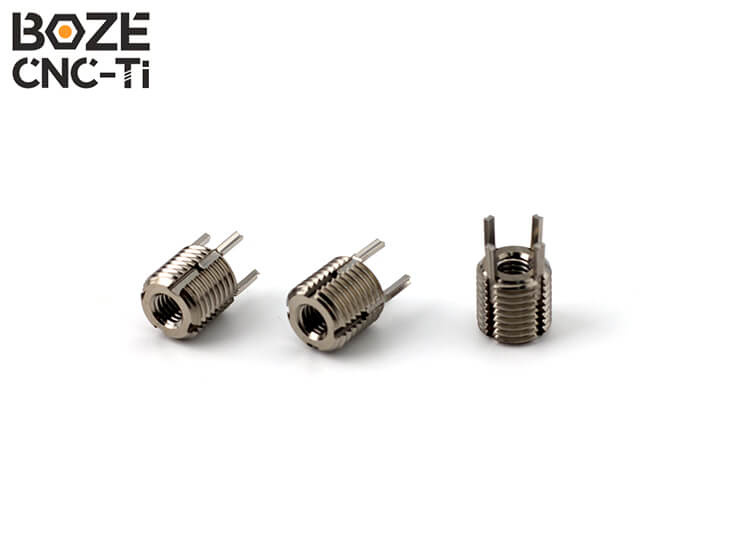
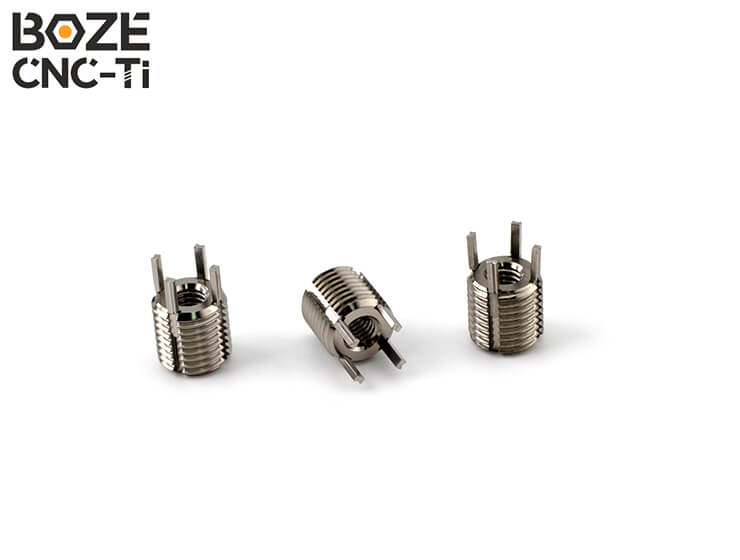
About Our Threaded Inserts
1. Threaded inserts are made from titanium alloy and come with 2 or 4 pre‑assembled locking inserts depending on size.
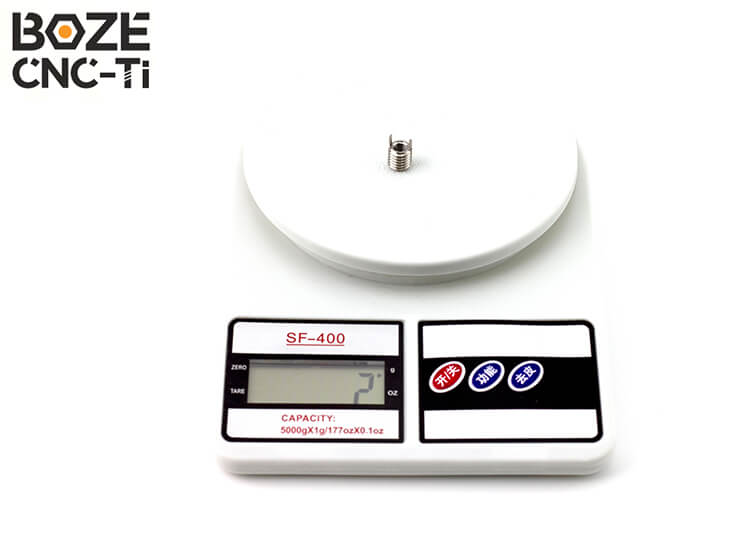
They are ultra‑light and corrosion‑resistant.
2. Once installed into the parent material, the insert forms a secure, form‑closed connection that prevents loosening.
3. Each type of threaded insert requires its own dedicated installation tool kit.
Threaded Inserts Function
1. They are used in aluminium alloys, light Materials, steel, and carbon fiber to increase the strength of the thread in these materials.
2. They can be used for thread repair, if the defected thread has to be replaced with the same nominal diameter.
Our Grade 5 (Ti-6Al-4V) Titanium Key-locking Inserts are the ultimate solution for creating permanent, high-strength threads in weak parent materials. Unlike standard titanium threaded bushings, the integrated locking keys prevent rotation due to vibration or high torque, making them essential for mission-critical hardware.
Why Choose Titanium for your Threaded Inserts?
1. Exceptional Strength-to-Weight Ratio
This is the "killer app" for titanium. It provides the strength of high-alloy steel but at roughly 45% of the weight.
Aerospace & Racing: In industries where "ounces equal pounds," titanium allows for high-torque thread reinforcement without the weight penalty of steel.
High Tensile Strength: Titanium Grade 5 (Ti-6Al-4V$) has a tensile strength often exceeding 130,000 psi.
2. Superior Galvanic Compatibility
When installing inserts into Carbon Fiber Reinforced Polymers (CFRP), steel and aluminum can cause a battery-like reaction that leads to rapid corrosion.
3. High Temperature Stability
Standard steel inserts can lose their temper or oxidize at high heat.
Heat Resistance: Titanium remains stable at operating temperatures where aluminum would soften and some steels would begin to scale. This makes them ideal for engine manifolds, turbine housings, or exhaust systems.
4. Total Corrosion Resistance
Titanium naturally forms a tenacious oxide film that is virtually "self-healing."
5. Permanent Mechanical Locking
Like all key-locking inserts, the titanium version uses the four-key system to provide a physical barrier against rotation.
Anti-Vibration: Unlike "Heli-Coils" or wire inserts that rely on tension, the keys create a mechanical interference fit. It cannot be backed out by vibration, even in high-stress environments like aerospace engines or heavy machinery
Threaded Inserts Parameter
2KEY-LOCKING THREADED INSERTS HEAVY DUTY |
NO | Internal thread(mm) | External thread(mm) | Length(mm) |
1 | M4X0.7mm | M8X1.25mm | 8 |
2 | M5X0.8mm | M10X1.25mm | 10 |
4KEY-LOCKING THREADED INSERTS HEAVY DUTY |
NO | Internal thread(mm) | External thread(mm) | Length(mm) |
1
| M6X1.0mm | M12X1.25mm | 12 |
2 | M8X1.25mm | M14X1.5mm | 14 |
3 | M8X1.0mm | M14X1.5mm | 14 |
4 | M10X1.5mm | M16X1.5mm | 16 |
5 | M10X1.25mm | M16X1.5mm | 16 |
6 | M12X1.75mm | M18X1.5mm | 18
|
7 | M12X1.25mm | M18X1.5mm | 18 |
8 | M14X2.0mm | M20X1.5mm | 20 |
9 | M14X1.5mm | M20X1.5mm | 20 |
10 | M16X2.0mm | M22X1.5mm | 22 |
11 | M16X1.5mm | M22X1.5mm | 22
|
12 | M18X1.5mm | M24X1.5mm | 24 |
13 | M20X2.5mm | M30X2.0mm | 30 |
14 | M20X1.5mm | M30X2.0mm | 30
|
15 | M22X1.5mm | M32X2.0mm | 32 |
16 | M24X3.0mm | M33X2.0mm | 33 |
17 | M24X2.0mm | M33X2.0mm | 33
|
Installation Instructions
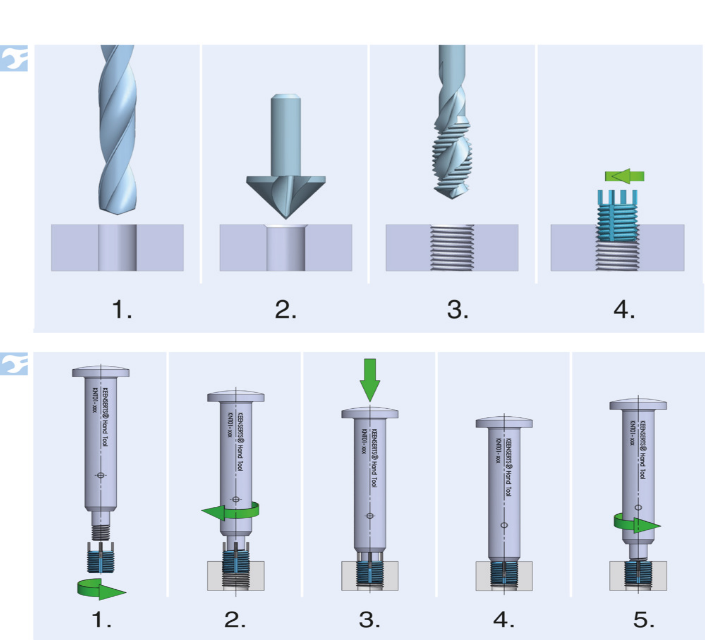
STEP 1-Drill the hole or drill out the old thread with a standard drill apply a chamfer if required.
STEP 2-Tap the new thread with a standard tap.
STEP 3-Install the threaded inserts by screwing it into the new thread. You can do this by hand, or by using the installation tool.
STEP 4-For inserts, the installation tool is used to drive inserts in, double check if the inserts are still straight every time you hammer them in.
Whether you are in Aerospace, Medical Device Manufacturing, or Subsea Engineering, our precision-engineered inserts ensure your assemblies stay secure under the most demanding conditions.
1. Common Compatibility Issues
Can titanium inserts be used directly for titanium base repairs?
A: Yes, but there is a high risk of galling between titanium and titanium, especially in high-torque or frequent assembly/disassembly scenarios, where long-term use is not recommended.
Why is titanium more prone to galling with titanium?
A: Due to the similar metallic properties leading to high friction and tendency for adhesion, surface reactivity and hardness close to each other will increase metal transfer and adhesion.
Is the use of dissimilar material inserts necessary?
A: In most maintenance and high maintainability requirements, stainless steel or nickel-based alloy inserts are recommended to reduce galling risk and improve durability.
2. Material selection and surface treatment
What alternative materials are recommended for titanium base material?
A: Common alternative materials include 17-4PH, A286, Nitronic 60, which are alloys that balance strength and anti-galling performance.
Can titanium inserts be surface-treated to reduce galling?
A: Yes, common methods include dry film lubricants, solid lubricant coatings (such as MoS₂), or anodizing combined with lubrication, which can significantly reduce friction and the probability of galling.
Is there a recommended lubricant or anti-galling coating?
A: For titanium parts, solid lubricants or high-temperature dry film lubricants are more commonly used, avoiding wet lubricants that may cause electrochemical corrosion.
3. Installation and Torque
How to reduce the risk of galling during installation?
A: Use appropriate pre-lubricants, control installation torque, adopt the correct installation tools and procedures, and avoid dry assembly or excessive torque impact.
Are there recommended installation torques or torque tables?
A: Recommended torque tables should be developed based on the insert material, thread specification, and parent material grade; if needed, we can provide reference torque suggestions for common sizes.
Installation steps and precautions for Key-locking inserts?
A: The standard steps include drilling → tapping or counterboring → inserting the insert → tapping in the locking key → finishing, paying attention to hole diameter tolerance, cleanliness and lubrication, avoiding repeated tapping that may cause deformation.
4.Maintenance and Removability
How should inserts be selected for applications requiring frequent disassembly?
A: Prioritize selecting dissimilar alloy inserts or titanium inserts with surface treatment, and use lubrication and appropriate torque control to ensure removability.
How to repair threads that have already occurred?
A: Depending on the extent of the damage, options include rethreading and installing a larger size insert, using a thread repair kit, or replacing the damaged component. In severe cases, it is recommended to send it for inspection and evaluation.
5.Design and Selection
How to select the appropriate insert material for a specific application?
A: Comprehensive judgment is made based on the base material grade, operating temperature, corrosive environment, load, and assembly/disassembly frequency; if necessary, we can provide material priority recommendations based on the conditions.
What are the advantages of Key-locking inserts compared to conventional inserts?
A: Better anti-rotation performance, more uniform load distribution, suitable for repairs and high-vibration environments, but material pairing still needs to pay attention to the bite problem.
6.Environment and Reliability
Suggestions for materials in high-temperature or marine environments
A: In high-temperature environments, prioritize selecting high-temperature alloys and use high-temperature lubricants; in marine or high-corrosion environments, prioritize using corrosion-resistant alloys and consider anti-corrosion coatings.
How is long-term reliability evaluated?
A: It is evaluated through fatigue tests, torque retention tests, and environmental accelerated aging tests. When necessary, it is recommended to conduct sample verification.
7.Purchasing and Customization
Do you offer customization for non-standard sizes or special alloys?
A: We support customization for non-standard sizes and various alloys, and can produce according to drawings or working conditions.
What information is needed to provide the best recommendations?
A: Please provide the base material grade, thread specification, operating temperature, load conditions, disassembly frequency, and environmental conditions.
8.Troubleshooting
What to do if stuck or experiencing abnormal torque after installation?
A: First, stop assembly and check lubrication, hole size, and insert integrity; if there is metal transfer or deformation, stop using it and contact technical support for on-site evaluation.
How to determine if it's a bites rather than a normal jam?
A: Bites are usually accompanied by abnormally high torque, metal galling, or surface adhesion marks; normal jams are often caused by impurities, hole size deviations, or installation angle issues.